Nedyalka Simeonova
A woman who set out from Haskovo and reached Carnegie Hall. The first Bulgarian woman to perform there. And still — almost forgotten.

My grandmother never spoke about her life as a hard one. And yet, when I think about it, that is exactly what it was.
She was born in 1938. She worked from nine to five, raised children and kept a home — in a world without a washing machine, without a dishwasher, without nappies, without conveniences. In a world where the day was not divided into "work" and "personal time", but simply ran on and had to be endured. Sometimes even without hot water.
One of the few pleasures she allowed herself was to have her hair set at the hairdresser once a week, to buy flowers at the market and to listen to music. But to listen to it properly — not as background, but letting herself be entirely absorbed by it.
It was from her that I first heard the name Nedyalka Simeonova.
I went looking through her story, but there was not much to find. A few recordings in the BNR archives and a handful of sparse articles online. Two recordings on YouTube — one of them of "Sevdana". A piece that makes you put down whatever you are doing and takes you back to a particular moment in your life, one that left a deep mark. The moment I began reading about Nedyalka Simeonova, that familiar feeling arrived — how is it possible that I had never heard of this person?
"A woman born in Bulgaria at the beginning of the twentieth century, who played perhaps the most competitive instrument of all — the violin — and did not merely play it, but gave concerts in Europe and America, won recognition, studied in Brussels, took prizes, made a name for herself."
In those years — without the internet, without television, without mass media. It sounds extraordinary.
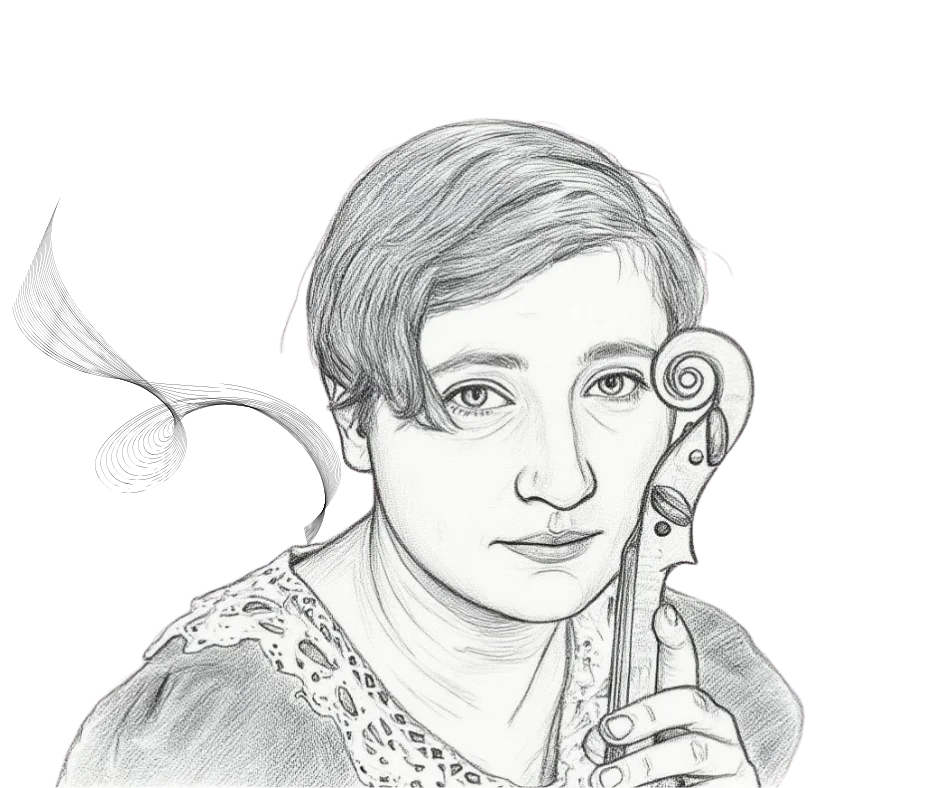
Nedyalka Simeonova was born in 1901 in Haskovo, and it was clear from childhood that this was no ordinary talent. She was sent abroad to study — no small decision even today, and at the time almost unthinkable. What followed were stages, tours and encounters with great musicians. She was the first Bulgarian woman to give a concert at Carnegie Hall. She had four husbands, the first of them the Indian El Adaros, whom she met in Chicago.
All of this exists as fact. It can be read. What cannot be reached so easily is what kind of person she was.
To set out from Haskovo and reach the world's stages while still a child, you are probably not merely talented. You must have had exceptional discipline. You must have borne loneliness. You must have moved through circles where you were a stranger. You must have had the character to withstand expectations — other people's and your own. Her life is recounted by a fellow citizen of Haskovo, the writer and physician Zhivka Shamlieva. It is thanks to her that we know what Nedyalka left behind.
At the age of forty-six she returned to Bulgaria. She began to play here, to teach, to be part of musical life in another way — not as the guest of a great stage, but as someone passing on her craft.
And somewhere there, at the same time, in the same city of Sofia, a woman like my grandmother was listening. Not in a concert hall, but at home. Between two tasks. Between obligations that would not wait.
"And I think this remains the truest measure of an artist's significance — not only the halls they played in, but the lives they touched."
Nedyalka Simeonova played on the world's stages, but she also reached kitchens like my grandmother's. People who would never be part of any cultural elite, yet who need culture no less.
And if this story has touched you — give it another five minutes and twelve seconds, and put down whatever you are doing.
Play "Sevdana" ♪