Collective Memory as a Cultural Process
The concept of “collective memory” is used to describe the ways in which societies create, preserve, interpret, and transmit their understandings of the past. The concept was introduced into sociology by the French sociologist Maurice Halbwachs in the 1920s and 1930s. In contrast to the understanding of memory as an exclusively individual psychological process, Halbwachs emphasizes that memories are formed and reconstructed within social groups and their “social frameworks” – family, religion, education, and other forms of social belonging (Halbwachs, 1992). Individuals do not remember as completely isolated entities; rather, they draw upon the language, categories, and symbols shared with the groups to which they belong.
In this sense, collective memory can be understood as a dynamic social process through which communities attribute meaning to the past and determine which events, individuals, and places are to be remembered and how they are to be interpreted. It is not simply an aggregate of historical facts, but is shaped through cultural, institutional, and societal practices. Monuments, museums, textbooks, rituals, anniversaries, and public narratives are among the mechanisms through which particular representations of the past are materialized and transmitted across generations.
This, however, raises one of the central theoretical questions in memory studies: does collective memory exist as an autonomous social reality, or does the concept refer to a socially organized aggregate of individual memories? Halbwachs himself lays the groundwork for this debate by simultaneously viewing individual memory as socially conditioned and speaking of collective memory as a phenomenon associated with groups and their shared frameworks of remembrance. In this sense, the collective and the individual cannot be completely separated: people remember individually, but they do so within a social environment that provides the categories, language, and symbols through which the past is understood and given meaning (Halbwachs, 1992).
Later scholars further developed this distinction. Jeffrey Olick, for example, differentiates between collected memory – the aggregate of individual memories understood as socially interconnected – and collective memory, which refers to the broader social and cultural forms through which the past is institutionalized and represented to the community (Olick, 1999; Olick, 2007). This distinction makes it possible to study collective memory not as some presumed “collective brain” of society, but through the concrete social practices, institutions, symbols, and forms of communication through which particular representations of the past acquire stability and persistence.
This perspective is particularly important for the study of cultural heritage. Collective memory is neither entirely independent of individual memories nor reducible to their simple arithmetic sum. It emerges at the intersection between individual memory and the social mechanisms that determine what is remembered, what is forgotten, and what becomes a publicly significant part of the past. Therefore, collective memory should primarily be understood as a social process of selecting, interpreting, and transmitting the past.
Artificial intelligence and memory
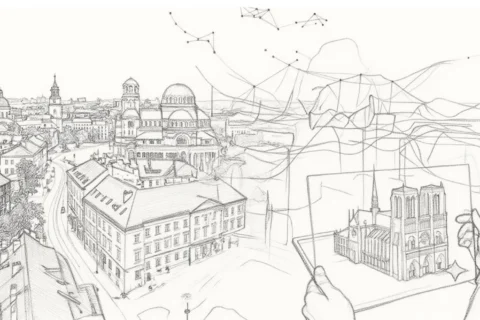
Artificial intelligence is gradually changing the way we create, store and interpret knowledge. In recent years attention has focused mainly on its application in medicine, industry, education and public administration. Far less often discussed is its influence on a seemingly conservative field — cultural heritage.
The digitisation of archives, libraries and museum collections is no longer limited to storing historical documents in electronic form. Thanks to generative artificial intelligence and advances in machine learning, digital collections can now be analyzed in ways that facilitate the identification of connections, patterns, and contexts across dispersed historical sources. Algorithms can analyse vast bodies of historical data, recognise relationships between individuals, institutions and places, reconstruct missing links between archival units, and uncover patterns that traditional archival research would struggle to establish.
This technological shift raises a more fundamental question.
If artificial intelligence begins to take an increasingly active part in presenting the past, can it change the way society forms its collective memory?
The question is not only about the possibility of creating more realistic visualisations or more accessible digital archives. It touches the very process by which societies decide which figures, events and places become part of the shared historical narrative. The discussion of artificial intelligence in cultural heritage is therefore not only technological. It is at once historical, ethical and political.
This article argues that the most significant impact of artificial intelligence on cultural heritage will not lie in automating archival work, but in changing the way society chooses what and whom to remember. This is why the development of AI raises a new question about collective memory — a question of public responsibility in the creation of historical narratives.
Cultural heritage as a process of selection
Cultural heritage is often understood as a collection of material objects — monuments, historic buildings, archives, works of art and museum collections. Such a view creates the impression that heritage is an objective reflection of the past. Contemporary work in heritage studies, however, shows this understanding to be greatly oversimplified.
As early as the late twentieth century, the historian David Lowenthal observed that heritage is not the past itself, but the way the present chooses to relate to it (Lowenthal, 1998). The past reaches us through a process of continual selection — certain documents are preserved while others are lost; some figures receive public recognition while others gradually disappear from public memory. Cultural heritage is therefore not a neutral archive of what happened, but the result of numerous institutional, political and social decisions.
This perspective also changes how we should view artificial intelligence. AI does not enter an empty space. It begins working with archives that have already been shaped by human choices and historical priorities. Algorithms do not create these selections, but they can reproduce them if the data they are trained on is not critically examined.
At the same time, AI offers a way to question those limitations. By processing large bodies of scattered information — local newspapers, registers, photographs, correspondence and administrative documents — the technology can make visible individuals and social networks that have so far remained outside the official historical narrative. In this sense artificial intelligence does not merely work with heritage; it potentially changes the way heritage is interpreted.
Sofia as a case study: between official history and the memory of the city
Sofia is a particularly interesting example for such an analysis. Over roughly the past 150 years the city has passed through several different political regimes, each of which formed its own vision of the past and, accordingly, set different criteria for public significance.
After the Liberation, the historical narrative understandably emphasised the building of the capital of the new Bulgarian state. Statesmen, military figures, architects and members of the political elite stood at the centre of public memory. During the totalitarian socialist regime, the public sphere came to be dominated by figures aligned with the ideological priorities of the time. After the democratic changes of 1989 the process of reassessing the communist past gradually began, and the focus on “national heroes” shifted entirely.
These transformations show that the memory of a city is never final. It is constantly rearranged in line with social values, political context and institutional practice.
At the same time, Sofia’s development was not shaped by political leaders or celebrated architects alone. The history of the city was also built by teachers, doctors, entrepreneurs, photographers, publishers, engineers, artists, small business owners, public figures and thousands of ordinary citizens whose biographies rarely appear in textbooks or museum displays.
This is precisely where the opportunity offered by artificial intelligence arises. Rather than being used solely to digitise archives, it can support the analysis of vast bodies of scattered information and uncover connections that would be difficult to trace by hand. This does not mean creating a new history, but widening the field of research through the systematic linking of sources that already exist.
Such an approach is already finding institutional application. In the Netherlands, the project HAICu (Humanities–Artificial Intelligence–Cultural Heritage) brings together the National Archives, the National Library (KB), the Netherlands Institute for Sound and Vision and several universities to develop AI tools for working with cultural heritage. Tellingly, the project does not concentrate solely on the technological possibilities of artificial intelligence. Among its central aims are the transparency of algorithms, the traceability of sources and the presentation of multiple historical perspectives. The very design of the project shows that the future of digital heritage is already regarded as a social question, not merely a technological one.
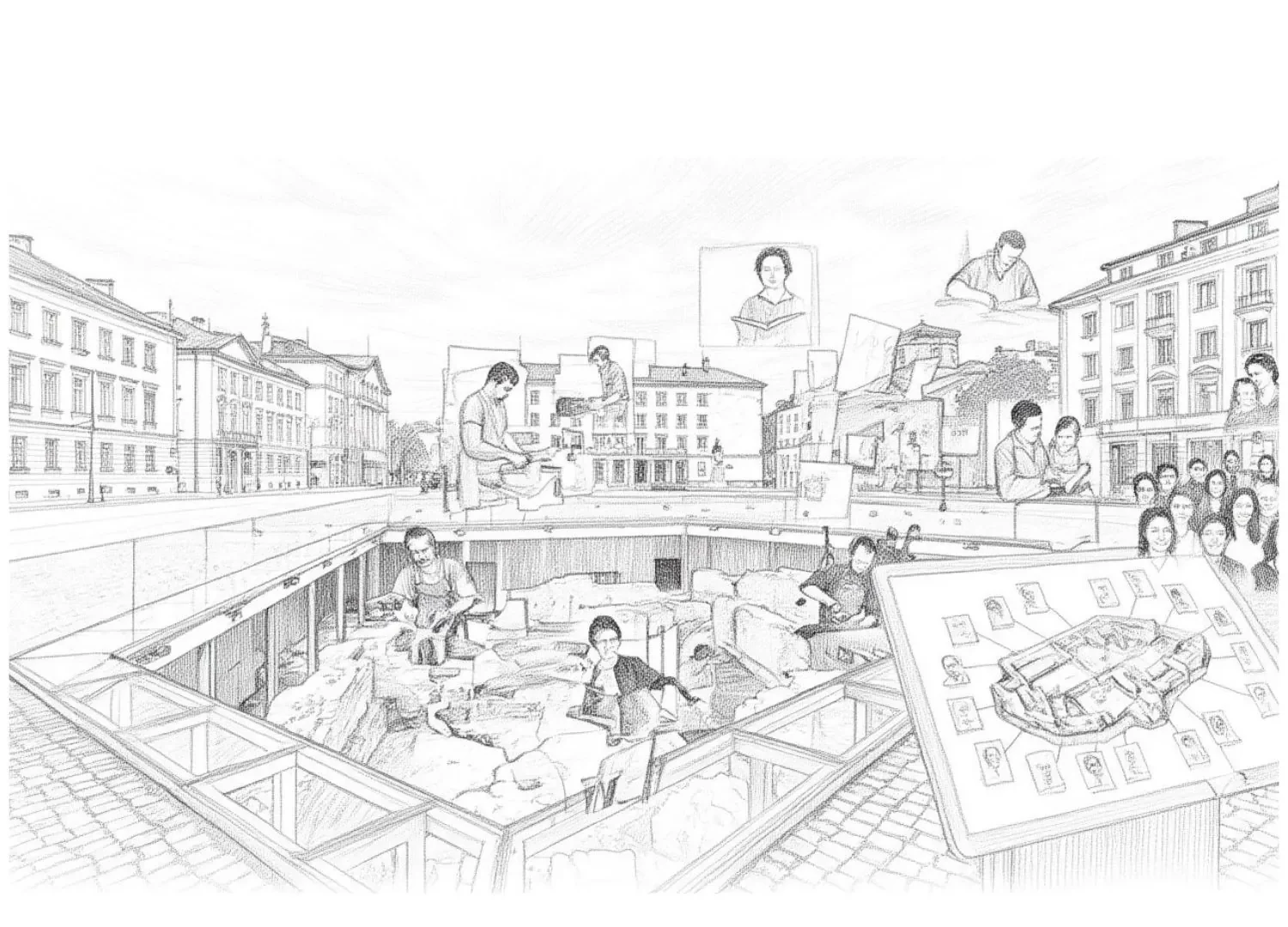
Such examples open new possibilities for Sofia as well. The digital holdings of the Sofia City Library, the State Agency “Archives”, the Regional History Museum – Sofia, the SS. Cyril and Methodius National Library and a number of private archives contain an enormous quantity of information that today exists largely as separate collections. With suitable AI tools these sources could be analysed together, making it possible to reconstruct the social, professional and cultural networks that shaped the capital’s development.
The central question thus gradually changes. Instead of asking only “What did Sofia look like?”, we begin to ask a more complex question: “Which people made Sofia what we know today, and why have some of them remained outside collective memory?”
It is here that artificial intelligence can become not merely a tool for digitisation, but a means of critically rethinking the memory of the city.
The ethics of reconstruction
As the capabilities of AI expand, new ethical questions arise. The more convincing digital reconstructions become, the more important the distinction between historical fact and algorithmic interpretation.
Every AI reconstruction is a sequence of choices. Sources must be selected, conflicting accounts assessed, gaps in the information filled, and the result finally visualised in a particular way. The algorithm therefore does not function as a neutral mediator between past and present. It takes part in the process of interpretation.
This is the process we try to follow in the projects of The Face of Sofia association, within which artificial intelligence was used to create audiovisual reconstructions of notable figures. Take the project “The Women of Lozenets” and the three figures at its centre — the actress Adriana Budevska, the teacher Penka Kasabova and the actress Irina Taseva. The aim was not to create an illusion of historical authenticity, but to offer an interpretation grounded in the most reliable documentary evidence available. The process began with historical research drawing on archive photographs, biographical sources, newspaper publications, memoirs and other documentary testimony. The next step was not the generation of images, but a critical assessment of the available data — how representative the photographs were, which facts were firmly established, and where gaps existed that could not be filled with historical certainty.
Only after this stage was AI used as a creative tool for visual and audiovisual reconstruction. Every decision — from the choice of expression and gesture to the intonation of the voice and the setting in which the women “come to life” — was the result of human interpretation, not an autonomous decision by the algorithm. The artistic element does not replace historical fact; it serves to present it more accessibly to a contemporary audience. In “The Women of Lozenets” it was not only the faces of the three women that were reconstructed, but rather their public presence. The aim was not to answer the question “What did they look like?”, but “What was their contribution, and why do we barely remember them today?”. AI thus becomes not a device for visual effect, but an instrument for recovering cultural memory.
Examples such as these show that the central challenge is not how realistic an AI reconstruction can be, but how transparent the process behind it is. A similar approach is reflected in the recent recommendations of ICOMOS Germany on the use of artificial intelligence in heritage conservation. The document stresses that AI should support expert work rather than replace it, and that every digital reconstruction must be traceable, clearly labelled as interpretation and based on a transparent methodology (ICOMOS Germany, 2025). The clearer the distinction between what is documented, what is a scientifically argued reconstruction and what is artistic interpretation, the greater the trust in such projects — and the smaller the risk that the technology will be seen as a substitute for historical research.
This is precisely what Luciano Floridi draws attention to: artificial intelligence is not an autonomous bearer of truth but a system whose results always depend on human decisions about the data, the model and the context of use (Floridi, 2023). Responsibility therefore lies not with the technology, but with the institutions and the people who determine how it is used.
Paradoxically, the more realistic digital images become, the greater the need for society to understand how they were made. Trust will no longer depend on the quality of a reconstruction alone, but on the transparency of the process behind it — and that, of course, carries its own risks.
The future of collective memory
The use of artificial intelligence in cultural heritage opens up possibilities that until recently seemed difficult to achieve. The capacity of algorithms to analyse large bodies of historical data, to find connections between scattered archival sources and to support the reconstruction of complex social networks creates new prospects for historical research. In this way AI can widen access to cultural heritage and make more visible those individuals and communities that have traditionally remained at the margins of the official historical narrative.
Herein lies its democratic potential. Used critically and transparently, artificial intelligence can support a rethinking of collective memory by revealing forgotten connections, local histories and social groups that have rarely featured in public interpretations of the past. In this sense the technology does not replace the historian, the archivist or the curator; it extends their analytical reach and creates the conditions for a more representative and more pluralistic understanding of history.
At the same time, the democratic potential of AI is by no means guaranteed — quite the opposite. AI can also pose a threat to our democratic society. Algorithms work with data that is already the product of historical choices, institutional practices and social priorities. If these limitations are not recognised, there is a risk that the technology will reproduce existing inequalities, or even deepen them, creating what is known as bias — turning historical prejudice into algorithmic prejudice. A still more serious risk arises when AI outputs come to be seen as an objective reflection of the past, without the process that produced them being visible.
If in the twentieth century the state, the museum and the textbook were the principal mediators between society and history, in the twenty-first century that role is gradually being shared with algorithms. This is why the question “Who has the right to be remembered?” inevitably becomes the question “Who determines what we will find when we search for history in the digital age?”.
The answer cannot be left to technology companies alone, nor to cultural institutions and experts alone. If AI is to take part in shaping public memory, its use must rest on transparency, scholarly reliability and democratic public oversight — meaning that decisions on a matter of public significance, such as the use of AI, should not be taken unilaterally but must be open to transparency, accountability and public participation and scrutiny. This is why it is increasingly understood that the future of digital cultural heritage depends not only on the development of algorithms, but on the creation of ethical and professional standards for their use. Only then could the technology, rather than replacing historical research, widen its horizon and make collective memory fuller, more critical and more representative.
Bibliography:
- Assmann, A. (2011). Cultural Memory and Western Civilization: Functions, Media, Archives. Cambridge University Press.
- Bowker, G. C. (2005). Memory Practices in the Sciences. MIT Press.
- Floridi, L. (2023). The Ethics of Artificial Intelligence: Principles, Challenges, and Opportunities. Oxford University Press.
- Halbwachs, M. (1992). On Collective Memory. Edited, translated, and with an introduction by Lewis A. Coser. University of Chicago Press. (Original work published 1950).
- Harrison, R. (2013). Heritage: Critical Approaches. Routledge.
- Lowenthal, D. (1998). The Heritage Crusade and the Spoils of History. Cambridge University Press.
- Manovich, L. (2020). Cultural Analytics. MIT Press.
- Nora, P. (1989). “Between Memory and History: Les Lieux de Mémoire.” Representations, 26, 7–24.
- Noble, S. U. (2018). Algorithms of Oppression: How Search Engines Reinforce Racism. New York University Press.
- Olick, J. K. (1999). Collective Memory: The Two Cultures. Sociological Theory, 17(3), 333–348. https://doi.org/10.1111/0735-2751.00083.
- Smith, L. (2006). Uses of Heritage. Routledge.
Documents and projects:
- AI4LAM. (2024–). Artificial Intelligence for Libraries, Archives and Museums. https://www.ai4lam.org
- Europeana Foundation. (2023–2025). DE-BIAS – Detecting and Cur(at)ing Harmful Language in Cultural Heritage Collections. https://pro.europeana.eu/project/de-bias
- HAICu Consortium. (2024–). Humanities–Artificial Intelligence–Cultural Heritage. University of Amsterdam. https://ahm.uva.nl/funded-research-projects/haicu-digital-humanities/
- ICOMOS Deutschland. (2025). KI und Denkmalpflege. Empfehlungen zum Einsatz künstlicher Intelligenz in der Denkmalpflege. Berlin: ICOMOS Deutschland.
- KB – National Library of the Netherlands. (2024). Artificial Intelligence and Cultural Heritage Projects. https://www.kb.nl
- UNESCO. (2021). Recommendation on the Ethics of Artificial Intelligence. Paris: UNESCO.